CS Degree Curriculum Design
As Head of the Software Engineering track at HIT, I developed a new CS curriculum proposal centered on Innovation-First Learning principles.
I do my best to align CS curricula with the real world, based on three decades of hiring, mentoring, and leading graduates in industry.
As Head of the Software Engineering track at HIT, I developed a new CS curriculum proposal centered on Innovation-First Learning principles.
Six third-year specialization tracks built on a shared CS foundation at HIT, each turning broad CS knowledge into job-ready expertise with a portfolio.
I established and led an industry advisory board to define practical readiness profiles for graduate roles, including AI engineer and full-stack developer tracks.
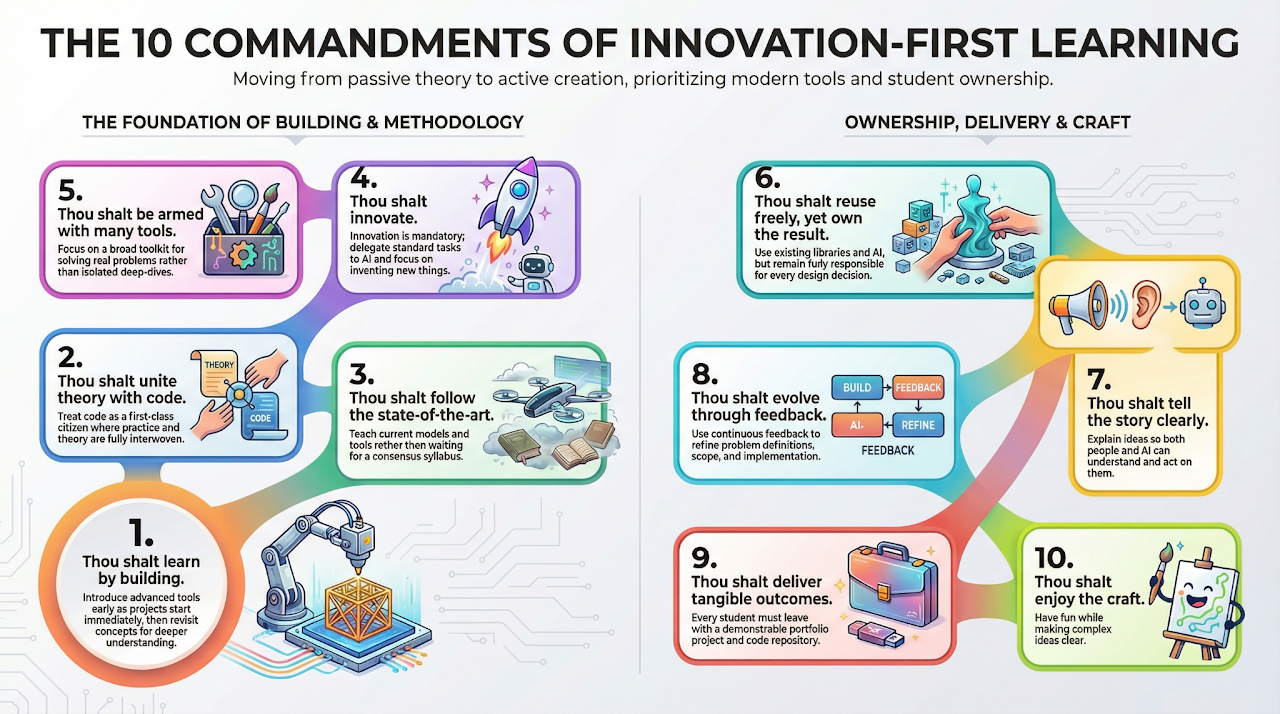
Innovation-First Learning bridges traditional CS education and current AI practice through deep theory, modern tools, and project work.
A five-criteria framework for evaluating advanced computer science electives by depth, industry relevance, system building, communication, and consolidation.
Diagnoses where the current CS elective track falls short, no clear prerequisite sequence, overlapping content that earns credit twice, and a narrow focus that leaves role gaps, and argues for electives that give students the complete, end-to-end toolkit industry expects.
A 13-week graduate course on generative modeling, spanning variational autoencoders, diffusion models, and world models.
A 13-week graduate course on large language models and agentic AI, covering modern LLM architectures, alignment, tool use, and multi-agent systems.
A 13-week graduate course on deep generative models for audio-visual data, covering VAEs, GANs, diffusion and the Stable Diffusion family, and synthetic data generation.
A 13-week undergraduate course applying large language models to NLP tasks with a code-first approach, spanning foundation models, fine-tuning, retrieval-augmented generation, and agentic AI.
A 13-week undergraduate course on deep generative models for visual data, covering VAEs, GANs, diffusion and the Stable Diffusion family, and synthetic data generation.
A 13-week undergraduate course tracing computer vision from image formation and classical image processing through classical vision and 3D reconstruction to deep learning for detection and segmentation, taught with a code-first approach.
A B.Sc. Digital Medicine course at Holon Institute of Technology (Spring 2026), applying large language models and agents to clinical and healthcare tasks, part of the Language AI track.
A B.Sc. Computer Science course taught at The Academic College of Tel Aviv-Yafo (Fall 2012), covering the geometry and algorithms of three-dimensional computer vision: camera models, multi-view geometry, stereo, and 3D reconstruction, foundational material for the Vision AI track.
A B.Sc./M.Sc. Computer Science course taught at Tel Aviv University (Spring 2015), covering algorithms and systems for large-scale data science: distributed data processing, scalable analytics, and the foundational techniques behind the Scalable AI track.