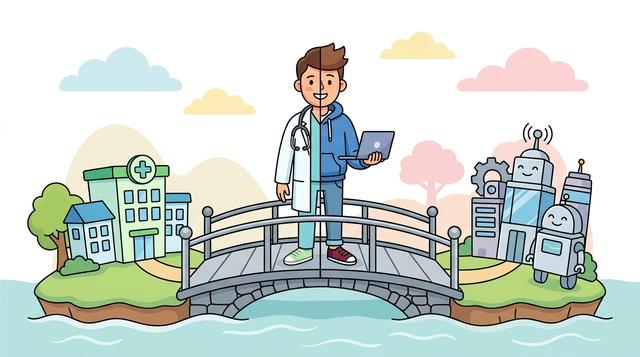
Medical Technology Students: Don’t Waste Your Cross-Domain Advantage

You are the rare student who sits where medicine meets AI. CS students have more raw tech; biomedical students know the clinic better; only you connect both. This project is where that shows, so do not spend it on something generic.

Four ways to make the project count

Turn the one thing only you have, medicine plus AI, into a project only you could do well.

1

Choose a meaningful problem

Pick a problem whose solution really needs medical understanding: real terminology, clinical nuance, practical constraints. If you could explain the whole domain in a 15-minute intro, it is too shallow.

The trap: a problem that is already solved, or so simple that the medicine is just a label stuck on a generic AI demo.

2

Develop deep domain understanding

Study the problem before you design a solution. Read the biomedical literature, existing systems, datasets, clinical practice, and regulations, and find the edge cases and risks a non-expert would miss. That depth is what separates your work from a generic AI project.

The trap: jumping straight to the model and learning the domain from a single Wikipedia page.

3

Maintain technological depth

Domain knowledge alone is not enough. Know what LLMs can and cannot do, which architectures, data, and evaluation fit, and where reliability breaks. The project should show you can make real technical decisions.

The trap: wiring a medical topic to an off-the-shelf LLM API and calling it a project.

4

Connect the two domains

The strongest projects link all of these:

  • a real medical or biomedical need;
  • deep understanding of its nuances;
  • a technically sound LLM-based solution;
  • rigorous evaluation on relevant criteria;
  • awareness of limitations, risks, and deployment.

The trap: strong medicine bolted onto weak AI, or slick AI solving a problem no clinician actually has.